Game prop artist
A single object looks convincing in a showcase, but the asset must also work from every gameplay angle.
Inspect the full mesh and plan for any topology or material cleanup before treating it as pipeline-ready.
kaedim examples 2022Evidence first
Kaedim reviews are most useful when they show the input, the resulting model, and the work required afterward. A polished render alone cannot tell you whether a mesh fits your production needs.
A favorable review can be informative without settling every production question. Start by separating what an example shows from what you still need to verify.
Treat Kaedim as a 3D creation workflow to evaluate against your own asset requirements, not as a guarantee that every reference becomes a finished production asset.
Note whether the example starts from a clear reference, a rough sketch, or a complex scene. Input quality affects how much the result can reasonably demonstrate.
Look beyond the presentation angle. Ask to see the back, underside, silhouette, and any areas that would need to deform, connect, or withstand close inspection.
List the cleanup, materials, UVs, rigging, or integration your project still requires. The useful outcome is the work saved after those tasks, not just the first visible result.
The right verdict changes with the job. These common scenarios show why one person's impressive result may not answer another person's most important question.
A single object looks convincing in a showcase, but the asset must also work from every gameplay angle.
Inspect the full mesh and plan for any topology or material cleanup before treating it as pipeline-ready.
kaedim examples 2022A concept is useful for visual exploration, while dimensions and assembly details remain unspecified.
Judge it as a visualization starting point rather than evidence of engineering accuracy.
kaedim 3dA review shows a finished image without showing the reference preparation or subsequent edits.
Follow a beginner workflow and record each manual step before estimating how repeatable the result is.
kaedim tutorial for beginnersAn example appears to save modeling time, but the team's required volume and terms have not been checked.
Compare current access terms alongside expected cleanup effort rather than judging value from the render alone.
kaedim pricingThese images illustrate what to compare, not a verified before-and-after test or a measured Kaedim output. Check shape, omitted details, materials, and the unseen sides when assessing a real review.
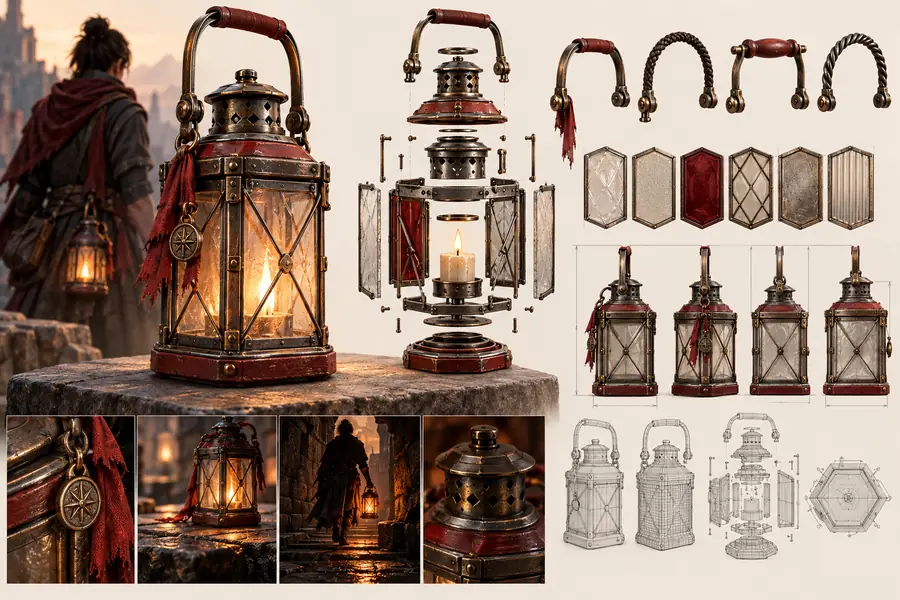

The first three rows address common misconceptions; the remaining rows turn them into practical checks. If a requirement cannot be verified from an example, do not assume the example meets it.
Misconception or risky assumption
What to check instead
Misconception or risky assumption
A good-looking image proves the underlying mesh is ready to ship.
What to check instead
Request mesh views, inspect hidden surfaces, and test the asset in its intended scene.
Misconception or risky assumption
One strong result predicts consistent results across unrelated references.
What to check instead
Try representative inputs, including difficult shapes, and compare the amount of rework.
Misconception or risky assumption
The initial output represents the total time required.
What to check instead
Include preparation, inspection, cleanup, and integration in the time assessment.
Misconception or risky assumption
Visual similarity is sufficient for parts that must fit together.
What to check instead
Use a dimension-controlled modeling process when tolerances and assembly matter.
Misconception or risky assumption
An appealing static shape is automatically suitable for deformation.
What to check instead
Check topology, articulation points, and rigging requirements before committing.
Misconception or risky assumption
An older review establishes today's available terms and workflow.
What to check instead
Confirm current conditions at the source and compare them with your actual workload.
Choose a representative asset, write down the geometry and delivery requirements, and compare the resulting work with your usual process. If you explore another 3D creation route, apply the same checks rather than relying on a showcase image.
Explore 3D creationThey can show what a reviewer liked or struggled with, but a finished render does not reveal every property of the asset. Look for input references, multiple model views, and an account of any edits made after the first result.
Prioritize reviews that identify the input, intended use, visible output, and remaining manual work. A description of the reviewer's experience is more useful when you can compare those conditions with your own project.
An older review may still illustrate useful evaluation questions. Do not assume its account of access terms, workflow, or available capabilities describes the current product; verify those details at the source.
Reviewers may use different references and judge success against different goals. A concept artist assessing visual direction and a game artist assessing topology can reasonably reach different conclusions about the same result.